
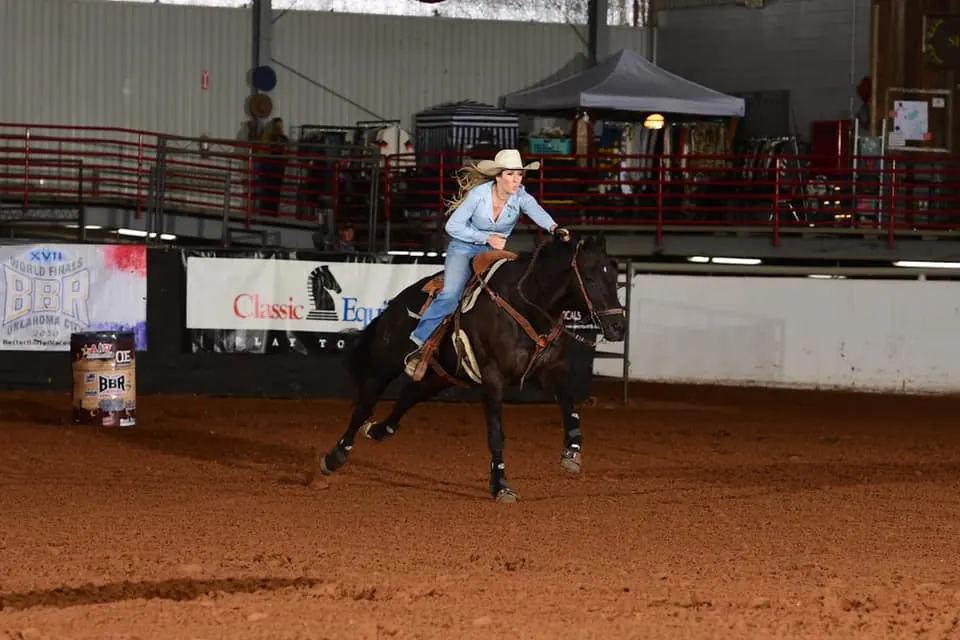
Positive reinforcement in barrel horse training.
What positive and negative reinforcement actually mean, why timing is everything, and how both fit a barrel horse program.
Positive reinforcement in horse training means adding something the horse finds pleasant — a scratch on the withers, a rest, a treat — immediately after it does what you asked, so it is more likely to do it again. It is different from negative reinforcement, which means removing pressure when the horse responds. Good barrel horse training uses both, with careful timing, so the horse understands exactly what earned the reward.
Positive vs. negative reinforcement
These terms come from learning science, and they get mixed up often. “Positive” and “negative” do not mean good and bad. They mean adding and removing. “Reinforcement” means anything that makes a behavior more likely to happen again.
- Positive reinforcement adds something the horse likes after the right response. Example: the horse stands quietly while being saddled, and you rub its neck.
- Negative reinforcement removes something the horse wants to get away from after the right response. Example: you apply leg pressure, the horse moves over, and you release the pressure. The release is the reward.
- Punishment is different from both. It aims to make a behavior less likely, and it is the least useful tool for teaching a horse what you want.
Most of riding runs on negative reinforcement. Every time a horse gives to the bit, moves off a leg or stops when you sit down, the release of pressure is what teaches it. That is not harsh; when pressure is light and the release comes at the right moment, it is clear, fair communication. Positive reinforcement adds another way to tell a horse “yes, that.”
Timing is everything
Horses connect a reward to whatever they were doing at the moment it arrived. A reward given late teaches the wrong thing. If a horse finishes a nice turn, then tosses its head, and only then gets a scratch, it may learn that tossing its head pays.
- Reward or release within a second or two of the correct response.
- Reward the try, especially early. A horse that offers a small step in the right direction deserves to hear about it.
- Be consistent. The same response should earn the same reward every time while a horse is learning.
Some trainers use a marker — a click or a short word — at the exact moment of the right behavior, followed by the reward. The marker bridges the gap between the moment and the reward. It is optional, but it can make timing much easier.
How positive reinforcement fits barrel training
Barrel horses work under pressure and at speed, so they need a clear understanding of what is wanted and a good attitude about their job. Positive reinforcement helps with both.
Building a willing attitude
Barrel horses that associate the arena with nothing but pressure tend to sour. Pairing good work with rest, a relaxed walk on a loose rein and a scratch on the withers helps a horse keep a positive association with its job.
Teaching calm in the alley and the warm-up
Many barrel horses get anxious in the alley. Rewarding a horse for standing quietly, walking calmly toward the gate or relaxing its neck helps build the calm behavior you want, instead of only correcting the nervous behavior you don’t.
Ending on a good note
When a horse gives you a correct turn or a soft stop, consider calling it a day for that exercise. Being finished is a reward in itself, and the last thing a horse did is often what it remembers.
Groundwork and handling
Loading in a trailer, standing for the farrier and accepting boots and wraps are all good places to use positive reinforcement, especially with young horses.
One caution: be thoughtful about where a horse earns its rest. Letting a horse stop and relax right at a barrel after every turn can teach it to want to stop there. Many trainers give the rest away from the pattern instead.
Common mistakes with rewards
- Rewarding the wrong moment. A scratch that lands after a head toss or a spook rewards the head toss or the spook.
- Holding pressure too long. If the release never comes, or comes late, the horse cannot tell what it did right and may start to brace or fight.
- Inconsistent rules. If a behavior is rewarded one day and corrected the next, the horse gets confused and anxious.
- Rewarding only perfection. Young or confused horses need credit for small tries, or they stop offering them.
Avoid over-rewarding and food pushiness
Treats are powerful, which is exactly why they need rules. Fed carelessly, they create a horse that mugs pockets, nips or crowds its handler.
- Treats come only for a specific behavior, never because the horse asks for them by nosing or nipping.
- Keep manners non-negotiable. A horse should stand with its head turned slightly away and wait. If it pushes, no treat.
- Use small amounts. A small piece is as effective as a handful and much better for the horse.
- Use non-food rewards often. Rest, a release, a scratch and a quiet word work well and carry no risk of pushiness.
- Fade rewards as behavior becomes reliable. Once a horse knows a task, reward it occasionally rather than every time.
Training at Rank Equine
At Rank Equine, Lexi Rankin trains barrel horses with clear communication: light pressure, a well-timed release and rewards the horse understands. Her barrel horse training includes tune-ups, starting colts on the pattern, conditioning and problem barrel horses — including horses that have soured or gotten anxious. Out-of-state owners can haul in for board-and-train. You can also read our five barrel horse training tips.
Have a horse that needs a fresh approach? Call or text Lexi at 817-600-3575.
Quick answers.
What is positive reinforcement in horse training?
Positive reinforcement means adding something the horse finds pleasant, such as a scratch, a rest or a small treat, immediately after it performs the behavior you want. Because the behavior earned something good, the horse becomes more likely to repeat it. Timing and consistency are what make it work.
Is releasing pressure positive or negative reinforcement?
Releasing pressure is negative reinforcement. “Negative” means something is removed, not that it is bad. When a horse moves off your leg and you release the pressure, the release rewards the response. Most riding cues work this way, and used with light pressure and good timing it is fair, clear communication.
Should you give a barrel horse treats?
Treats can work as long as they follow rules: give them only for a specific behavior, never when the horse begs or pushes, keep pieces small and insist on manners. Non-food rewards like a release, a rest or a scratch on the withers are just as useful and carry no risk of making a horse pushy.
How fast should you reward a horse?
Within a second or two of the correct response. Horses link a reward to whatever they were doing the moment it arrived, so a late reward can teach the wrong behavior. Some trainers use a click or short word as a marker at the exact moment, followed by the reward.
Let’s talk about your horse.
Tell Lexi where your horse is today and where you want to be. She’ll give you an honest read and a plan — whether you’re down the road in Jacksboro or hauling in from out of state.