
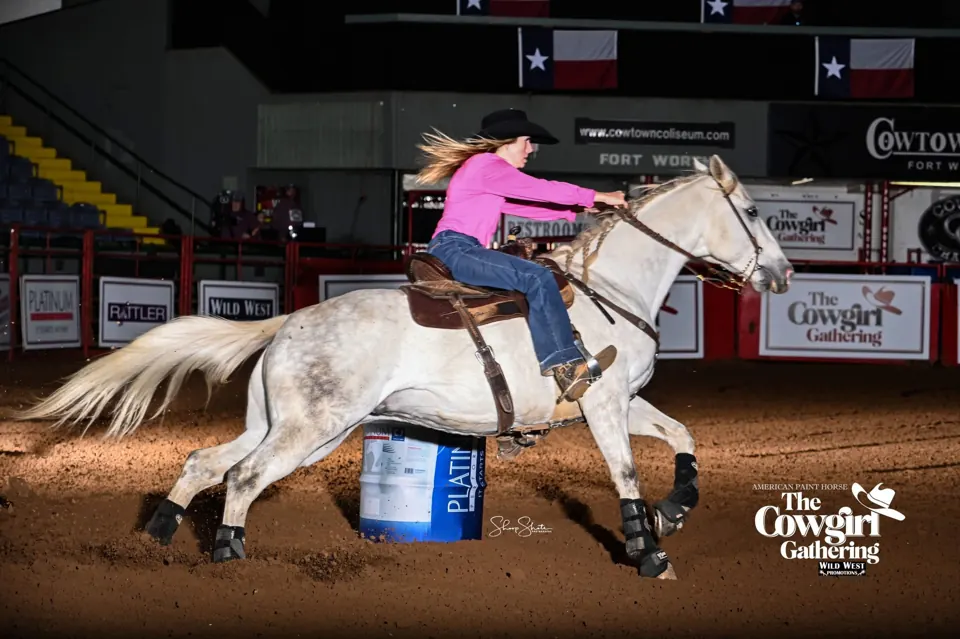
The barrel racing pattern: measurements, rules & diagram.
How the cloverleaf is laid out, how far apart the barrels go, and how to run it clean, with a diagram of the standard pattern.
The barrel racing pattern is a cloverleaf run around three barrels set in a triangle. On the WPRA standard pattern, barrels 1 and 2 are 90 feet apart, barrel 3 is 105 feet from each of them, and the start/finish line is 60 feet from barrels 1 and 2. The rider makes one right turn and two left turns, or one left and two right, then runs home through the timer. The fastest time wins.
What is the barrel racing pattern?
Barrel racing is a timed event. Three barrels — 55-gallon drums at sanctioned rodeos — are set in a triangle: barrels 1 and 2 side by side across the arena, and barrel 3 at the far end, centered between them. The horse and rider start with a running start, cross the start line to start the clock, turn all three barrels in a cloverleaf, and cross the same line again to stop it. That one line, usually marked by an electric eye, is both the start and the finish.
The “cloverleaf” name comes from the shape of the path. Each barrel is circled once, so seen from above the run traces three loops joined in the middle, like a three-leaf clover.
Barrel pattern measurements
The Women’s Professional Rodeo Association (WPRA) sets the standard most people mean by a “full-size” or “standard” pattern. Its rule book lists:
- 90 feet between barrel 1 and barrel 2.
- 105 feet from barrel 1 to barrel 3, and from barrel 2 to barrel 3.
- 60 feet from barrels 1 and 2 to the score line (the start/finish line).
- At least 18 feet from barrels 1 and 2 to the side fences.
- At least 30 feet from barrel 3 to the end of the arena.
- At least 70 feet of stopping distance past the score line, to the end of the arena or the end of a run-out alley.
The three pattern distances are maximums as well as the standard. Under WPRA rules no pattern is set larger than the standard without board approval, and the largest pattern the arena and ground conditions allow should be set, up to those numbers.
Other associations write their own rules. The National Barrel Horse Association (NBHA), which runs its races in a divisional format, sets minimum clearances for its shows: at least 15 feet from the first two barrels to the side fence, at least 30 feet from the third barrel to the back fence, and at least 30 feet from the timeline to the first barrel.
How to run a barrel pattern, step by step
The order never changes: barrel 1, then barrel 2, then barrel 3, then home. What the rider chooses is which side to start on.
- Enter and cross the line. The rider comes in with a running start, and the clock starts when the horse crosses the start line.
- Turn the first barrel. Pick the right or left barrel. Going right first, the horse runs to the right-hand barrel and circles it to the right, keeping the barrel on the rider’s right side.
- Cross to the second barrel. Leaving barrel 1, the horse runs across the arena to the opposite barrel and circles it the other way. On a right-first run, that is a left turn.
- Go to the third barrel. From barrel 2 the horse runs to barrel 3 at the far end and turns it in the same direction as barrel 2.
- Run home. After barrel 3 the horse runs straight back down the middle of the pattern and across the start/finish line, which stops the clock.
Either way, the pattern is one turn in one direction and two in the other. The WPRA rule book describes it exactly that way: one right and two left turns, or one left and two right.
Right or left first barrel?
The rider decides. Both directions are legal, and both produce the same cloverleaf in mirror image. Many riders choose the side their horse turns best on. Whatever the choice, it has to be the same pattern from start to finish: one turn one way, two the other.
Penalties, knocked barrels and no-times
Penalty rules depend on who is sanctioning the race, so it pays to read the rules or ground rules for each event.
- Knocking over a barrel. In WPRA competition, each knocked-over barrel adds a five-second penalty. Under NBHA rules, knocking a barrel completely over is a no-time. In both, simply touching a barrel is allowed.
- Breaking the pattern. Missing the cloverleaf — going off pattern — is a disqualification under WPRA rules and a no-time under NBHA rules.
Five seconds is an enormous margin in a sport decided by hundredths of a second, so in practice a knocked barrel usually takes a rider out of the money either way.
Why barrel patterns aren’t all the same size
Arenas come in every size, and the standard pattern doesn’t fit in all of them. WPRA rules handle smaller arenas in steps:
- If the arena allows, keep the standard pattern and shorten the score line.
- If that still doesn’t fit, reduce the pattern proportionately, keeping the distance between barrels 1 and 2 shorter than the distance from each of them to barrel 3.
- Keep barrels 1 and 2 at least 18 feet from the sides of the arena, and never closer than 15 feet even in extra-small arenas. Barrel 3 must be at least 25 feet from the end.
- Allow at least 50 feet of stopping distance, or 45 feet in an extra-small arena.
That is why times can’t be compared from one arena to another. The pattern in the Thomas & Mack Center in Las Vegas, where the National Finals Rodeo is held, is much smaller than a standard set, so winning runs there land in the low 13-second range, while the fastest runs on a full standard pattern are in the 16-second range.
Setting up a practice pattern
For practice at home, measure with a long tape rather than pacing it off, and set the standard 90/105/60 pattern if your arena has room for it plus the fence clearances. If it doesn’t, scale the whole pattern down evenly rather than squeezing one side. Mark each barrel spot with a stake or other marker, as rodeos do, so you can reset the barrels in exactly the same place after a knock and track real progress. Most of the work on the pattern happens at a walk and trot, not at full speed; our five barrel horse training tips explain why.
Learn the pattern with Lexi at Rank Equine
Lexi Rankin, owner of Rank Equine, is a champion barrel racer who qualified for the 2021 BBR World Finals in Oklahoma City and competes in UPRA rodeos. In her barrel racing lessons, riders learn horsemanship, a balanced seat and control first, then the pattern and speed when they are ready: reading a setup, rating to the turn, the run between barrels and a straight finish. Lessons are private or small-group at the ranch near Jacksboro, about an hour northwest of Fort Worth, which has full-size barrel practice patterns and warm-up areas. If your horse is the one struggling on the pattern, see our barrel horse training, and if you’re new to the sport, start with why girls should get into barrel racing.
Source: WPRA Rule Book, rules 12.3, 12.7 and 12.11 (wpra.com); NBHA 2025 Official Rulebook (nbha.com); BarrelRacing.com, “The Fastest Times Ever Ran on Barrel Racing Standard Pattern” (barrelracing.com).
Want help with your pattern? Call or text Lexi at 817-600-3575.
Quick answers.
What are the measurements of a barrel racing pattern?
The WPRA standard pattern is 90 feet between barrels 1 and 2, 105 feet from barrel 1 to barrel 3 and from barrel 2 to barrel 3, and 60 feet from barrels 1 and 2 to the start/finish line. Barrels 1 and 2 sit at least 18 feet from the side fences and barrel 3 at least 30 feet from the end of the arena. Smaller arenas use a smaller pattern.
Do you go right or left first in barrel racing?
Either. The rider chooses whether to start with the right or the left barrel, and many choose the side their horse turns best. A right-first run is one right turn at barrel 1, then left turns at barrels 2 and 3. A left-first run is the mirror image: one left turn, then two right.
What happens if you knock over a barrel?
It depends on the association. In WPRA competition, each knocked-over barrel adds a five-second penalty to the time. Under NBHA rules, knocking a barrel completely over results in a no-time. Touching a barrel without knocking it over is allowed in both.
What happens if you break the barrel pattern?
Going off pattern, meaning failing to complete the cloverleaf correctly, gets no time. WPRA rules call it a disqualification and NBHA rules call it a no-time. Either way the run cannot place, regardless of how fast it was.
Let’s talk about your horse.
Tell Lexi where your horse is today and where you want to be. She’ll give you an honest read and a plan — whether you’re down the road in Jacksboro or hauling in from out of state.